
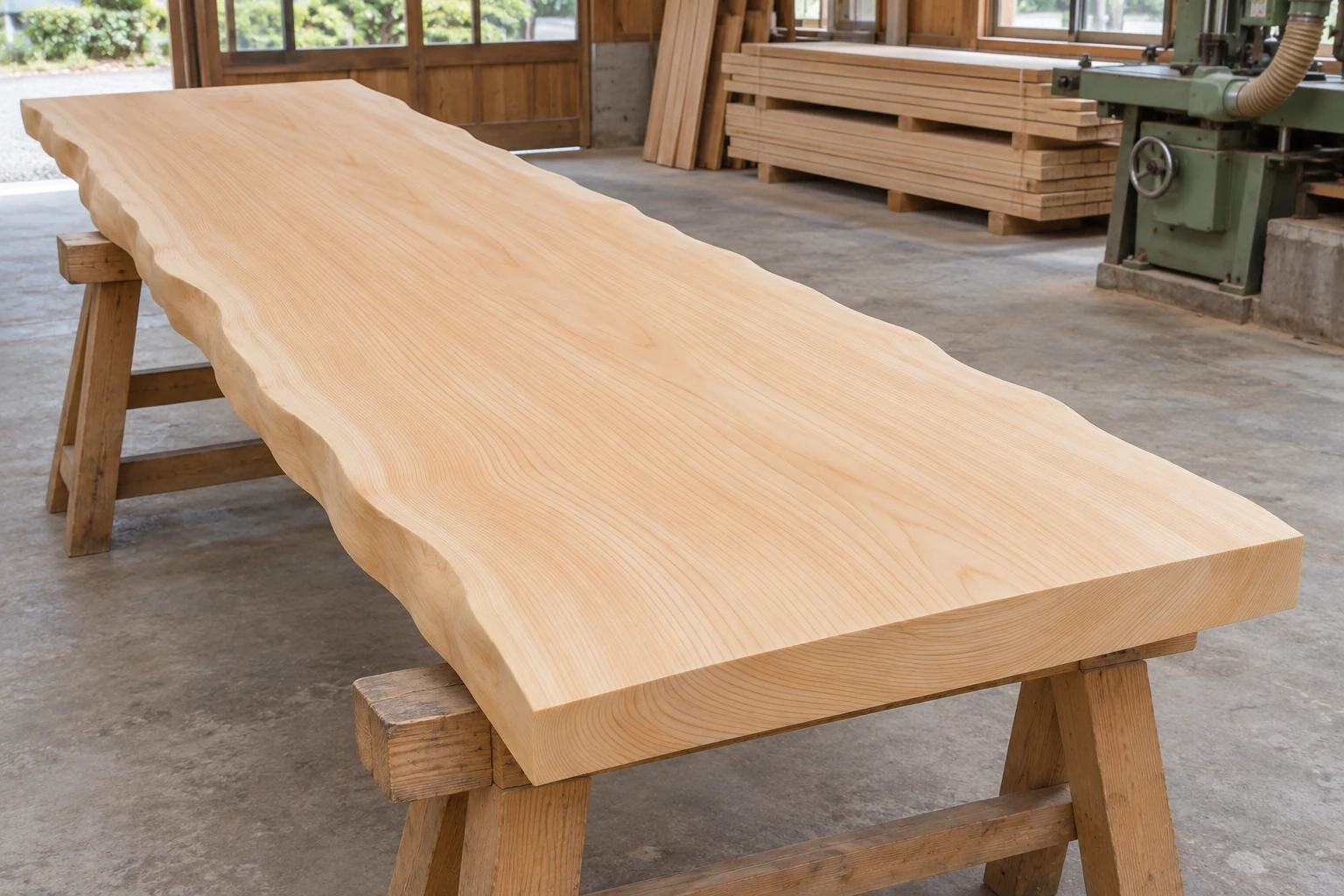
A hinoki single slab is cut from one log, without joining separate pieces to increase its width or length. It is well suited to tables and counters where you want to show uninterrupted grain and a natural live edge.
When sourcing, consider the character of the wood you want to show, the dimensions that will remain after machining, and whether the slab can be finished to suit its intended use.
Why Choose a Single Slab?
A single slab lets you make continuous grain, a natural outline, and the distinctive knots and color of that particular piece part of the furniture's design. These features can be enjoyed across the full surface of a large tabletop, such as a dining table or counter.
When You Want Continuous Grain and a Natural Live Edge
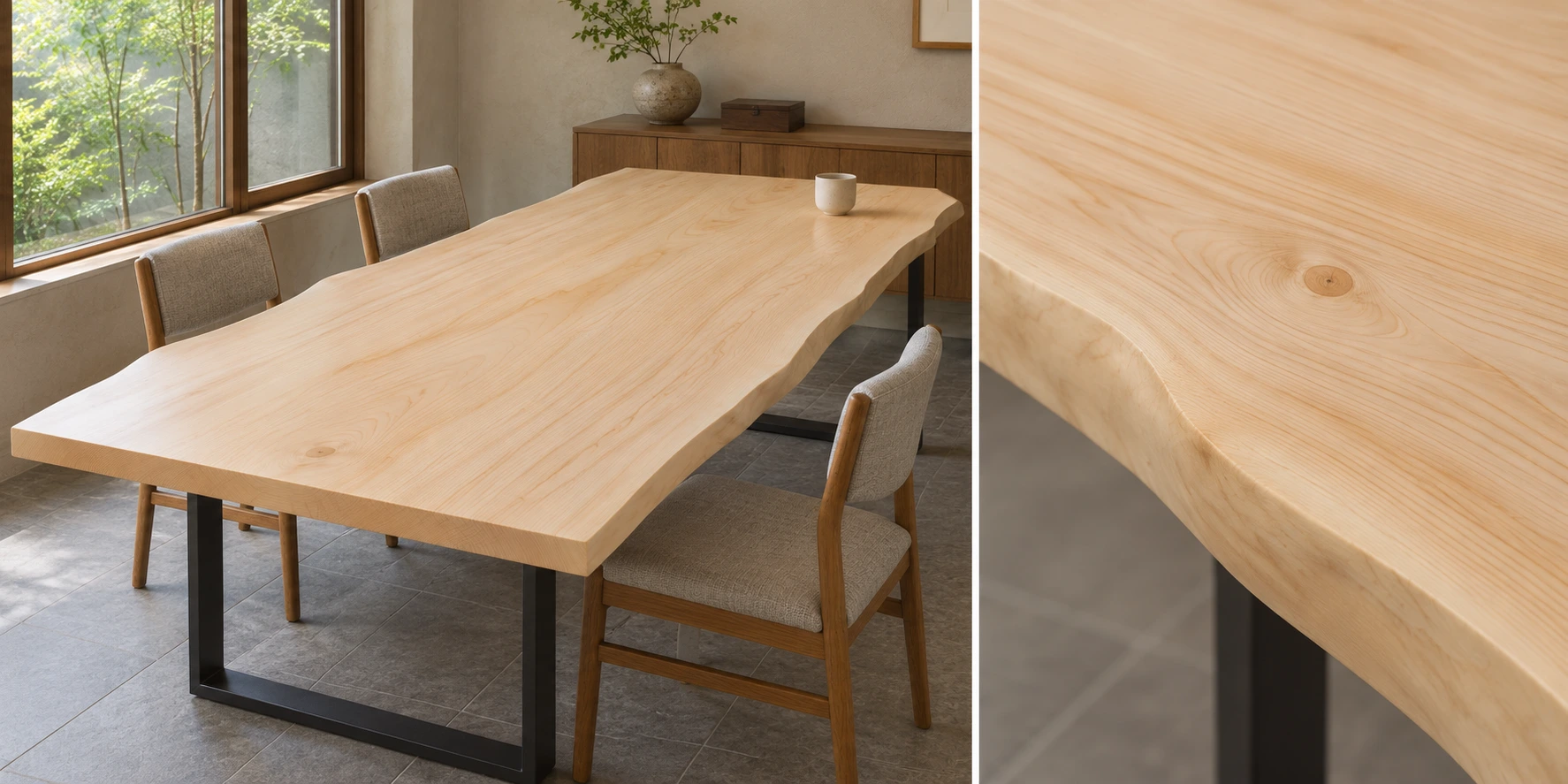
Left: a hinoki live-edge single-slab table. Right: grain curving around a knot and a live edge that retains the wood's natural outline.
On a single slab, the grain runs from one end of the board to the other without changing at a joint. It suits applications such as dining tables, reception counters, and display stands where you want the grain to flow across a broad surface.
The natural outline along the bark side of a board is called the live edge. Keeping it gives the furniture a changing width and gentle curves. It can bring a natural wood outline into a rectilinear space or make the front edge of a counter a design feature.
Incorporating the Grain, Knots, and Color of Each Piece
Grain patterns, knot locations, and color differences between heartwood and sapwood vary from one slab to another. A single slab suits designs that incorporate this variation instead of aiming for a uniform appearance.
For example, the features of a particular slab can give character to a counter that shows its knots or a low table that retains the board's outline. Even when cut into a rectangle, the grain and color variation across the surface remain visible.
Making Use of Hinoki's Light Color and Fine Texture
Hinoki single slabs also offer a light color, fine texture, sheen, and fragrance. These qualities can work well in light-toned tables and display stands, as well as reception counters that people touch.
A single slab is suited to applications where you want to retain continuous grain and the live edge, and show knots and color variation. Hinoki adds a light tone and fine texture to that appearance.
Uses That Can Also Be Served by Other Wood-Based Materials
When you need multiple pieces in consistent dimensions or a single slab does not fit the budget, edge-glued panels, glued laminated timber, and wood veneer over a substrate are also options. The number of wide boards that can be sawn even from a large log is limited, so there may be few candidates when you need to match width, length, and knot characteristics as well. Sawmilling and drying also take time and care, so single slabs tend to be expensive.
If seamless grain or a natural live edge is not essential, a panel made by gluing several pieces together or a substrate faced with natural wood may meet the need. The suitable construction differs between a tabletop that shows the thickness of solid wood and a door or interior panel that shows a wood-grain surface.
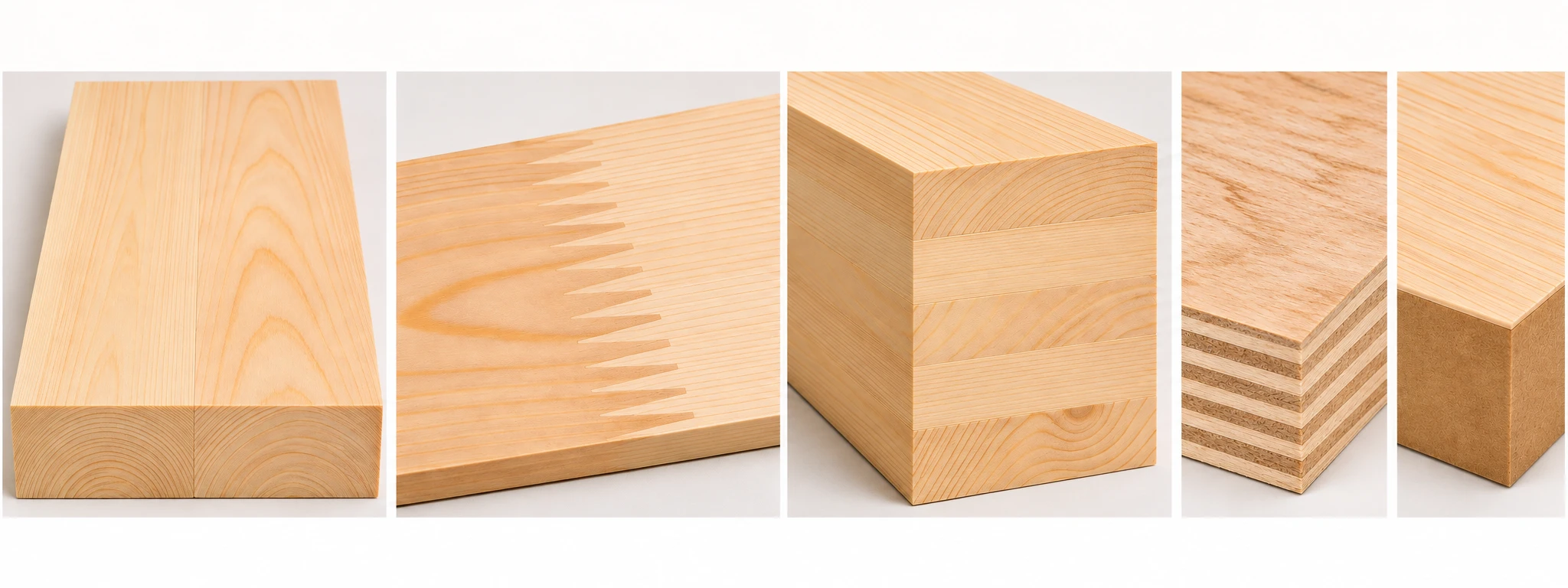
From left: a two-board edge-glued panel, finger-jointed material, glued laminated timber, and wood veneer on plywood and MDF substrates.
Edge-Glued Panels and Two-Board Panels
An edge-glued panel is made by bonding multiple boards side by side across their width. A two-board panel is one example; the grain and color change at the glue line. This construction can suit rectangular tables, desks, and shelves when you need several pieces in a particular width.
Finger-Jointed Material and Glued Laminated Timber
Finger jointing connects pieces lengthwise by machining their ends into interlocking finger shapes. Glued laminated timber is made by bonding sawn boards or small square members with their grain aligned. Layered material like the one in the image shows its layers on the side or end grain. These materials are used for furniture, shelves, and built-in components that require consistent dimensions.
Plywood and Wood-Veneered Panels
Plywood is made by bonding thin wood layers with their grain directions crossing. A wood-veneered panel has a thin layer of natural wood bonded to a substrate such as MDF to show the wood grain; it is used for cabinet doors and interior panels. The appearance also changes depending on whether the edge is covered with edging material or the cross-section is left visible.
Edge-glued panels and glued laminated timber are candidates for tabletops that show the thickness of wood, while wood-veneered panels can suit doors and interiors where the grain is shown on the surface. Focusing single slabs on the areas where their distinctive appearance matters can make it easier to select materials to fit the quantity and budget.
Dimensions and Material Condition to Check When Sourcing a Single Slab
Choose stock that will retain the required length, width, and thickness after machining, and can be finished in a condition suited to its use. How the live edge is treated, drying, defects and repairs, and surface protection all affect the usable area and final result.
Usable Length and Width
The width of a live-edge slab varies along its length. If the tabletop will retain the live edge, check that the narrowest point across the intended length is wide enough. If you will cut a rectangle, the required length and width must both fit within the interior area after removing the live edge and trimming any splits. Maximum width or log diameter alone is not enough to make this decision.
Finished Thickness
Rough-sawn stock shrinks as it dries, and more thickness is removed when planing it flat to remove cupping or twist and sanding it. Start with the required finished thickness and choose a slab that will retain it after machining. Rough stock at the desired thickness may not be ready to use as is.
Drying and Wood Movement
Check the drying method and measured moisture content, and select stock dried to suit the interior where it will be used. Stock that is not sufficiently dry should be conditioned, for example through further drying, before finish machining.
Even after drying, wood absorbs and releases moisture in response to ambient humidity and expands and contracts across its width. Restraining this movement with legs or rails can lead to cracking. Use a mounting method that allows the board to move, such as elongating screw holes across the width.
Defects and Repairs
If there are end checks, see whether enough length will remain after cutting them off. Knots and repair marks look different depending on whether they are shown on the top or turned toward the underside. Where a smooth surface is needed, such as for writing, avoid holes and chips or repair them so the surface is level.
Surface Protection for the Intended Use
Hinoki is relatively soft, so consider the properties required for the surface in use and how to protect it.
- Display stands and reception counters: Prioritize the appearance of the wood and a smooth surface for contact. Use protective mats in areas where items are frequently placed.
- Writing desks and workbenches: In addition to a smooth surface, account for pressure from writing and objects placed on it. Protect the work area with a desk mat or similar covering.
- Dining tables and food-service counters: Surfaces should resist staining and be easy to wipe clean. If stain management is the priority, polyurethane coating is one option. If you choose an oil finish to retain the feel of the wood, include prompt wiping and periodic recoating in its care.
Surface protection from a finish and the wood's resistance to dents are separate properties. Do not expect a coating alone to eliminate softness; combine protection measures according to how the surface will be used.
Even a large slab can have a different usable area after trimming and flattening. Base your selection on the dimensions that will remain after machining and the condition of the surface in use after the work is complete.
Representative Japanese Hinoki Regional Brands and Their Characteristics
Information about regional brands can be useful when you want to communicate the history of forest management as part of the value of furniture or a space, alongside the grain and color. The features to focus on vary depending on whether you want to highlight a light tone, regular grain, or the forestry background of the region.
| Regional brand and area | Grain and material characteristics | Example of use | Forestry and regional background |
|---|---|---|---|
| Kiso hinoki · Kiso in Nagano Prefecture through the Ura-Kiso area | Fine, attractive grain | Refined counters that show fine grain; fixtures that tell the story of the region | Known as a region for natural hinoki. Distinct from plantation-grown timber in the Kiso area |
| Tono hinoki · Tono in Gifu Prefecture and some surrounding areas | Pale pink color, sheen, and fragrance | Bright interior furniture that makes use of the pale wood color | A timber brand from the Tono region |
| Yoshino hinoki · Yoshino in Nara Prefecture | Fine, even annual rings, few knots, and pale pink heartwood | Refined tabletops and fittings that show an even grain pattern | Forests are cultivated through dense planting followed by pruning and thinning |
| Owase hinoki · Around Owase City and Kihoku Town in Mie Prefecture | Straight trunks with little taper, few knots, and dense annual rings | Built-in components that show straight grain and annual rings | A region where dense planting, pruning, and thinning have been practiced to produce heart-centered posts |
Shibushi: A Distribution and Export Hub for Southern Kyushu Timber
Shibushi Port in Shibushi City, Kagoshima Prefecture, is a timber export hub, and wood from southern Kyushu is brought there. Information that a shipment left from Shibushi Port describes its distribution route; it does not mean the wood was grown in Shibushi City.
Regional characteristics can help you find candidates that suit the desired appearance or story. Connecting a candidate slab's grain and color with its forest-growing history can explain why that piece was selected, in terms of both appearance and background.
Summary: Reasons to Choose a Single Slab and Sourcing Criteria
Hinoki single slabs suit furniture designs that show continuous grain and a natural live edge. Their light color and fine texture can also be reasons to choose them.
When sourcing, consider how much of that character will remain alongside the usable area after machining. Usable width changes depending on whether the live edge is retained or cut square, while drying, flattening, and trimming splits affect the finished dimensions. Repairs and surface protection also need to suit the intended use.
From among slabs whose grain and live edge appeal to you, select one that will retain the required length, width, and thickness after machining and whose surface can be finished to suit its use.
For advice on timber for a specific application, see ALTO's sourcing services. For characteristics of other species, see the wood species guide.