
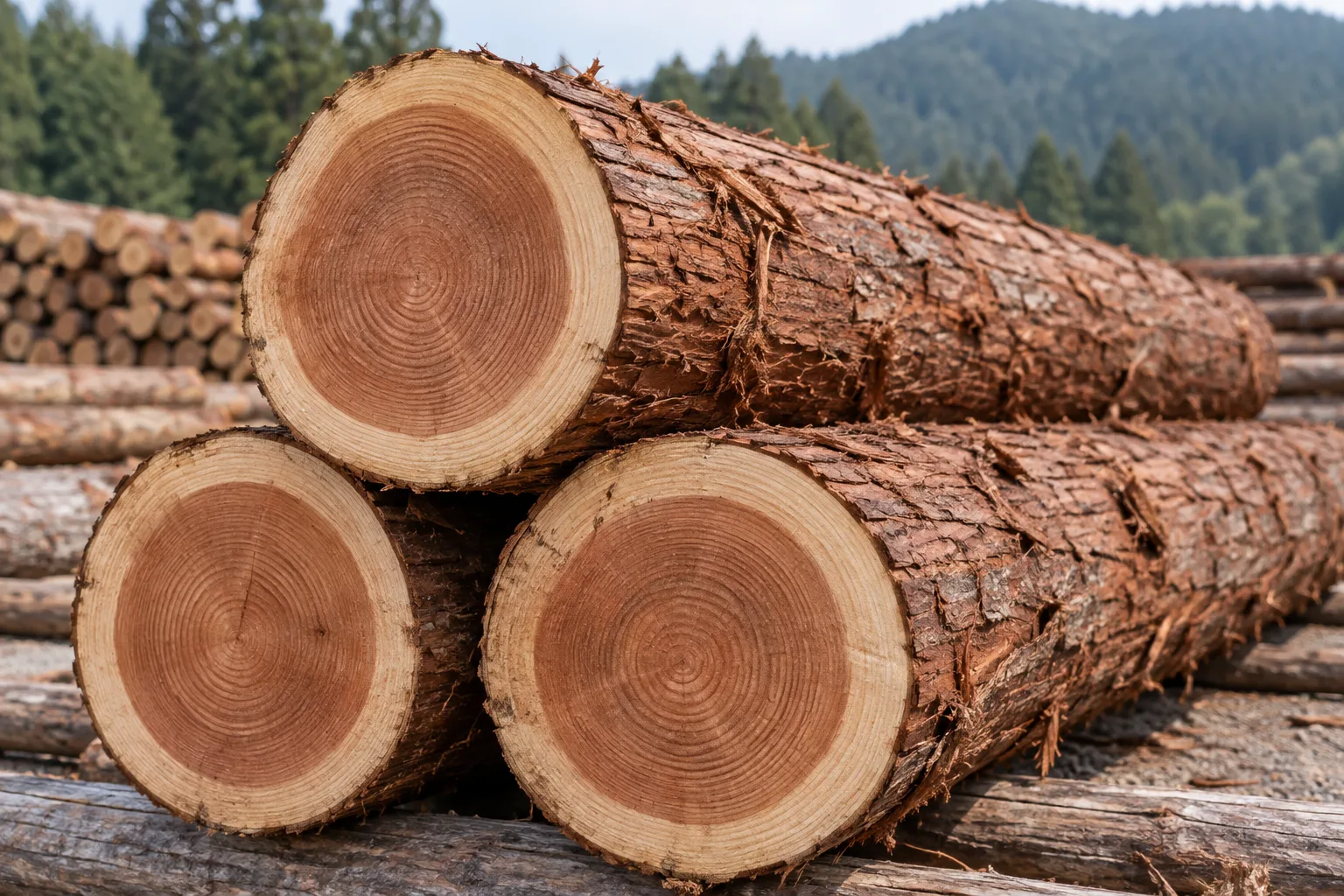
Pale wood carries flowing reddish-brown grain, and feels lighter in the hand than its appearance might suggest. Sugi combines expressive grain with ease of use, making it one of Japan’s best-known timbers.
It has long been used not only in buildings but also in furniture, vessels, and sake barrels. Even within sugi, color and grain vary with region, cultivar, and how the trees are grown. Knowing these differences can change how familiar wooden objects look to us.
1. A history of use in Japan: how applications shaped forest management
The history of sugi is filled with ingenuity in growing and processing trees for particular uses.
In Yoshino, in the mountains of Nara Prefecture, planting was already under way around 1500. As production of boards for sake barrels grew from around 1720, demand for timber expanded. Methods developed for planting trees densely, thinning them repeatedly, and growing them over a long period. The fine, even grain seen in Yoshino sugi today also reflects generations of forestry shaped by the needs of its uses.
In Kitayama, Kyoto, sugi has been produced for about 600 years. For teahouses and other architecture, craftspeople developed Kitayama maruta: logs whose natural form is retained while the surface is polished. This is a tradition of turning the log itself into a beautiful architectural element. It also gave rise to the distinctive daisugi technique, which grows several straight trunks from a single stump.
Sugi has supported everyday life in Japan while also shaping different forest landscapes for different purposes.
2. Basic characteristics of sugi: lightness and expressive grain
One of sugi’s appeals is the contrast between the reddish “heartwood” at the center and the pale “sapwood” around it. Its growth rings are also distinct. Depending on how it is sawn, straight grain can look neat and composed, while cathedral grain can feel open and expansive.
The timber is relatively light and soft, which also makes it easy to work. Its gentle woody fragrance and natural feel suit interiors and everyday items where the touch of wood is part of the experience.
Compared with hinoki, sugi is generally lighter and softer, with more pronounced differences between its red and pale areas and more visible growth rings. Where hinoki has a fine, even surface, sugi invites appreciation of movement in the grain and changes in color.
Sugi also stands out for its lightness and softness compared with white oak, which is used for furniture and flooring. It can dent more easily when used as flooring, but its surface can be compressed with heat and pressure through a process called densification to increase hardness. With an oil finish that preserves the feel of the wood, light scratches can be sanded and the surface recoated. A protective coating and densification serve different purposes.
Solid wood also absorbs and releases moisture in response to the surrounding humidity. Its drying condition and the environment where it is used affect how it performs.
3. Regional characteristics and what lies behind them
Differences in sugi are shaped by more than climate. Cultivar, planting density, branch pruning, growing time, and processing methods all affect the appearance of the timber.
Akita sugi from northern Japan has a history of being used for ceiling boards, interior materials, and magewappa bentwood containers. Magewappa are made by bending thin boards. These uses draw on the fine, even grain of timber from natural forests. Today, plantation-grown sugi is the main source, and forestry that grows trees over a long period continues. The forestry backgrounds of natural forests and plantations differ.
Yoshino sugi from Nara Prefecture is valued for its fine, even growth rings and pale reddish hue. Dense planting, repeated thinning, and branch pruning over many years produce straight timber with few knots.
Kitayama sugi from Kyoto is known for the beauty of its polished logs. Careful pruning from an early stage helps grow straight trunks, whose surfaces are polished to bring out their sheen. Used as columns and decorative elements that show the tree’s form, they have a presence distinct from sawn boards.
Oguni sugi, grown in Oguni and Minamioguni in Kumamoto Prefecture, Kyushu, consists mainly of two cultivars: “Yabukuguri” and “Ayasugi.” Ayasugi is appealing for its pale pinkish heartwood and wavering grain reminiscent of bamboo grass leaves. Even in the same region, appearance changes with the cultivar.
Obi sugi from the Nichinan area of Miyazaki Prefecture in southeastern Kyushu has been used for wooden boats, drawing on its lightness, high oil content, and resilience. It was used even for curved parts of hulls, and today its applications have expanded to buildings, furniture, and wood products.
4. Bringing out sugi’s characteristics through processing and design
Combining the character of a growing region with processing and design can bring out sugi’s appeal or address practical challenges in a particular use.
| Use | Useful characteristics and practical considerations | Processing or design that makes use of its character |
|---|---|---|
| Flooring | Enjoyably soft underfoot, but prone to dents | Increase hardness and reduce denting by compressing the surface with heat and pressure through densification |
| Small furniture and storage boxes | Light and easy to carry, but prone to scratches | Use sugi for the main body and, where appropriate, combine it with harder wood only for high-stress parts such as the top |
| Walls and ceilings | Distinct growth rings and contrast between red and pale areas | Quarter-saw for straight grain and a composed look, or plain-saw to show larger cathedral patterns |
| Columns and decorative material | Kitayama sugi and other sugi can be grown into straight trunks with few knots | Keep the trunk as a log rather than sawing it into boards, then polish its surface to show its form and sheen |
Several regional types of sugi may suit a single use. For structural timber, the product must meet the required strength, dimensions, and drying condition; the region name alone is not enough.
In summary: bring sugi’s diversity into spaces and everyday life
Sugi shares the qualities of being light and soft, yet shows a wide range of character depending on where and how it is grown. The even grain of Yoshino, polished logs from Kitayama, and the varied colors and patterns of Oguni each reflect both nature and human activity.
Knowing where timber comes from reveals its character; understanding how it is processed shows how that character can be used. Connecting the material, how it is made, and where it will be used opens up possibilities for wood in products and spaces.
Explore the range of Japanese timber products offered by ALTO.